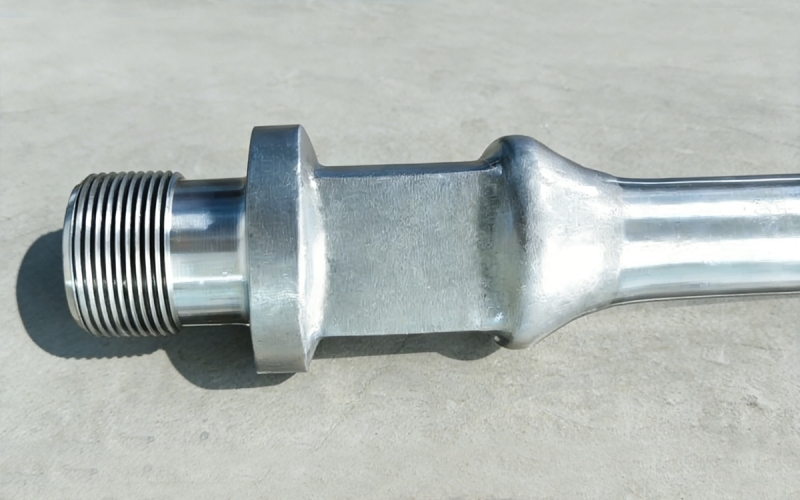
Sucker rod, as traditionally defined, commonly refers to the solid steel sucker rod. It is a core component in sucker rod pumping technology, connecting the surface pumping unit with the downhole rod pump, transmitting the reciprocating power from the surface to the downhole pump, thereby lifting crude oil to the surface. It is an internationally standardized product with a wide range of specifications, complete grades and mature manufacturing processes. It can be selected and adapted (by rod body diameter) according to different pump hanging load requirements. With a relatively low price, it is the most widely used rod pumping tool in the world.
The product structure has been optimized through long-term engineering practice. Every geometric modification is designed to resist the complex alternating stresses encountered downhole, aiming for longer fatigue life and operational reliability.
The solid round cross-section of the smooth rod is the main component subjected to alternating tension-compression loads, and its cross-sectional area determines the load-bearing capacity. The smooth surface reduces fluid resistance and friction during reciprocating movement within the tubing.
Manufactured using the end-upsetting process, both ends are hot-upset to form coupling sections with a significantly larger diameter than the rod body. Threads are machined on the enlarged couplings, avoiding cross-sectional weakening caused by cutting threads directly on the rod body. The upset transition zone adopts a smooth arc transition, ensuring gradual cross-sectional changes and greatly reducing the stress concentration factor at this location to prevent fatigue crack initiation.
Standard thread with 10 threads per inch, a 60° thread angle, and formed by rolling, offering high interchangeability. Since the threaded connection bears most of the load, extremely high requirements are imposed on thread machining accuracy and surface integrity.
Designed for holding with a special wrench during makeup and breakout operations, preventing tool damage to the threads.
When the sucker rod is tightened to the coupling, the rod's bearing surface is in close contact with the coupling's bearing surface to bear structural loads. After tightening, the tension/compression loads of the rod string are transmitted directly through this pair of metal surfaces, rather than the threads bearing shear forces, thereby greatly improving the strength and fatigue life of the connection and assisting in forming a metal-to-metal seal.



The selection of materials is rigorous and reliable, adopting high-quality alloy steel from regular large manufacturers. The smelting composition is stable, the metallographic structure is uniform after heat treatment, and the strength and toughness meet the requirements of conventional working conditions.

With large batch sizes and mass production, the production quality control methods have been verified over a long period of time, ensuring reliable performance.
The company has been deeply engaged in the R&D and manufacturing of sucker rods for many years, with complete large-scale production capacity for sucker rods, nearly 20 years of API 11B certification, and stable quality.
With large product usage volume, it effectively reduces fixed production costs. Customers benefit from low procurement expenses and high cost-effectiveness.
It adopts standardized and mature production processes. The manufacturing processes for key procedures are mature and stable, with high dimensional accuracy, good straightness, and a wide range of applications.



Scan the QR Code